
I Didn’t Know I Was Wintering: What Katherine May’s Wintering Reflected Back to Me

This post contains an affiliate link. If you choose to purchase through it, I may earn a small commission at no extra cost to you. I only ever share books and resources I genuinely love and would recommend.
I Didn’t Know I Was Wintering
Last year, I didn’t know I was wintering.
I hadn’t read Katherine May’s book.
I didn’t have language for what was happening.
All I knew was that I needed to be quieter, slower, more inward.
I stepped back from people.
I stepped back from social media.
I stepped back from the version of myself that kept pushing through.
At the time, it didn’t feel poetic or wise.
It felt confusing. Lonely at times. Necessary in ways I couldn’t explain.
When I finally read Wintering, it didn’t teach me something new. It recognised me.
One of the first lines that stopped me was:

It named what I was already living.
That was it.
I hadn’t been in a dark, cold season on the outside. Life looked fine. But inside, something in me had gone into a different rhythm. A quieter one. A slower one.
I hadn’t chosen it.
I didn’t announce it.
I just… withdrew.
And I didn’t know that’s what wintering was.
From the Inside, It Felt Like This
That line kept echoing for me as I thought about last year.
Nothing dramatic happened on the outside. There was no clear beginning, no obvious ending. Just a slow, quiet pulling in.
I stopped wanting to do as much.
I didn’t have the energy to show up in the same ways.
I needed more space; not to escape life, but to sit with it.
From the outside, it might have looked like I was stepping back.
From the inside, it felt like something was settling.
Wintering didn’t arrive with frost and darkness.
It arrived with tiredness. With less tolerance for noise.
With a deep need to be still in ways I’d never needed before.
I didn’t fight it.
But I didn’t understand it either.
Somewhere Else
Katherine May writes about “Somewhere Else”; a place where time runs differently, where life carries on around you, but you don’t quite move at the same pace.
That idea stayed with me.
“There are gaps in the mesh of the everyday world, and sometimes they open up and you fall through them into Somewhere Else.”
I’ve been in “Somewhere Else” more than once in my life.
Sometimes through burnout.
Sometimes through hormonal shifts.
Sometimes through loss and grief.
Sometimes through changes I didn’t choose.
There was a time in 2018 when life cracked open like that. Everything moved on, but I didn’t. I won’t name what happened. It’s deeply personal, and I’m not ready to hold it in public yet. But I know now that I was wintering then, too.
Time felt strange.
The world felt loud.
And I felt like I was living slightly out of sync with it.
I didn’t know there was a word for that.
This Isn’t a Flaw. It’s a Pattern
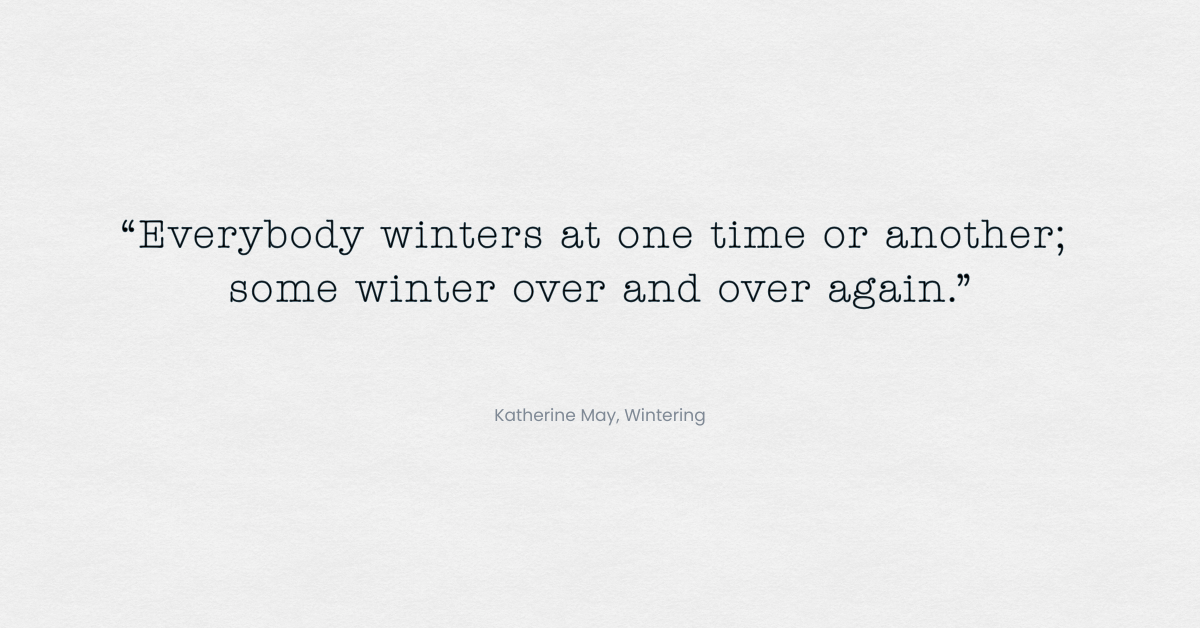
That sentence felt like someone gently telling me: this isn’t a flaw, it’s a pattern.
When I look back, I can see wintering woven through my life.
From my teens, I’ve had seasons where I’ve needed to withdraw.
Often labelled as depression.
Now, with a later understanding of ADHD, I can see many of those times were more likely burnout.
In 2000, I left a career I’d gone into straight after college. I was young, ambitious, working in retail management, climbing quickly. From the outside, it looked like success. From the inside, it didn’t feel like mine.
I remember one evening vividly, it was Boxing Day, a Sunday. I’d worked a long, exhausting day of sales and returns. I walked to my car because the park-and-ride bus had stopped running. I was tired in every sense of the word. And as I walked, I knew: I don’t want this life anymore.
That night, I decided my New Year’s resolution would be to change career.
The following year, I left. And before starting my next job; making sandwiches while I studied with the Open University. I had a week of nothing. No structure. No plans. No pushing.
At the time, it felt like collapse.
Now, I see it for what it was: wintering.
I had to stop before I could start again.
Learning My Winters
“I began to get a feel for my winterings: their length and breadth, their heft. I knew that they didn’t last forever. I knew that I had to find the most comfortable way to live through them until spring.”
That feels like wisdom that only comes with having wintered before.
Last year, even when I felt low or withdrawn, I didn’t panic in the way I once would have. Somewhere inside me, I knew: this won’t last forever. I don’t need to fix it. I just need to live through it gently.
I pulled back from people.
I pulled back from Mindful and Me.
I pulled back from relentless posting and proving.
I didn’t go on retreat.
I didn’t disappear from life.
I did the work quietly, inside ordinary days.
Thinking. Writing. Resting. Listening.
Letting myself be slower than the world around me.
I didn’t call it wintering then.
But that’s what it was.
Why We Hide Winter
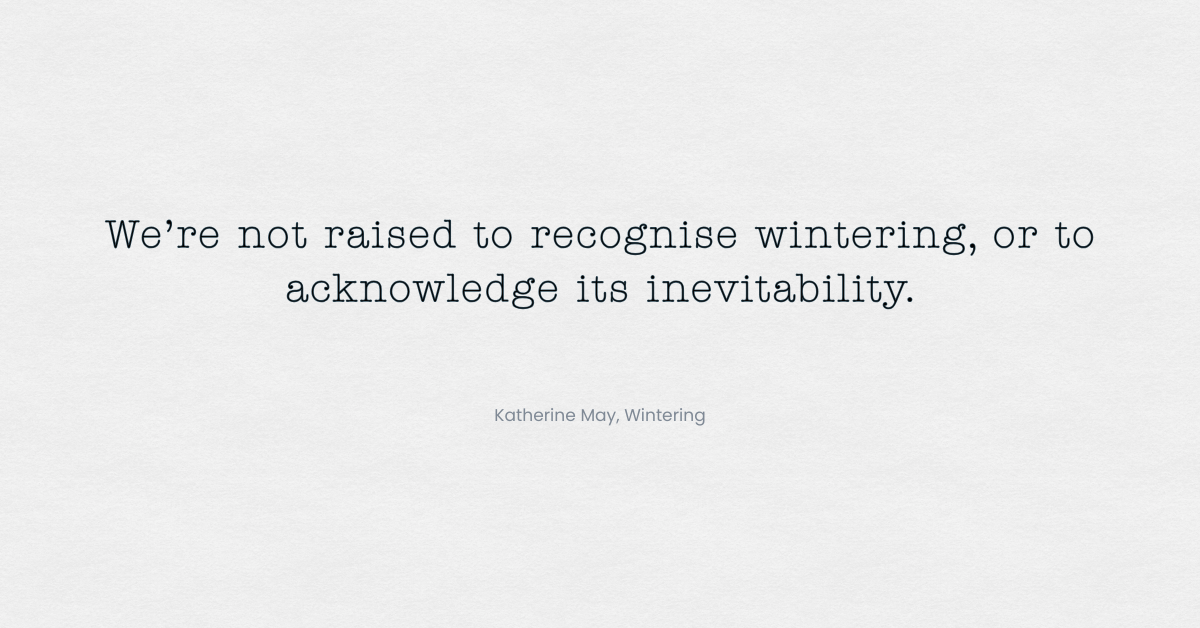
We’re taught to cope quietly.
To carry on.
To be grateful, capable, resilient.
If we slow down too much, something must be wrong with us.
If we withdraw, we’re failing.
If we can’t keep up, we should try harder.
So when wintering arrives, we hide it.
“We treat each wintering as an embarrassing anomaly that should be hidden or ignored.”
Looking back, I can see how often I’ve done that.
Calling burnout “just being tired.”
Calling grief “just needing time.”
Calling overwhelm “just me not coping very well.”
Putting on a brave face.
Grieving privately.
Not wanting to make other people uncomfortable with my slowness.
But wintering isn’t rare.
It’s ordinary.
It’s part of being human.
And hiding it comes at a cost.
What Wintering Gave Me
Wintering hasn’t taken from me. It has shaped me.
Last year changed how I live in ways I’m only just beginning to see.
I started to question my work-life balance.
Not in a dramatic way, just quietly noticing what drained me and what didn’t.
I began to imagine a different future.
One with more space.
More choice.
More room to be present.
That quieter reimagining eventually led me to think differently about what I want to make space for. I explored that more in What I’m putting in next year’s diary and quietly starting now.
I found more capacity to be the mum I want to be to my teenage daughter, not just physically there, but really there.
Less rushing.
More listening.
More noticing.
I had more energy for the things I love.
Not because I did more, but because I did less.
This year, I’ve already started slowly reconnecting with people.
Last year, it was too much. I withdrew.
Now, I’m finding my way back, gently.
I’ve also come to understand myself more deeply, especially through a later-in-life self-diagnosis of ADHD. So many past winters suddenly made sense. Not as weakness, but as nervous systems asking for rest.
I wrote more about that process in I’ve Been Wondering… Is This Me?
Wintering Also Changed My Work
I chose to work freelance for the first time and become a virtual assistant.
I stepped away from Mindful & Me when it felt like too much.
I let myself question what I really wanted it to be.
Not to abandon it, but to reshape it.
That happened inside ordinary days.
Not on retreat.
Not in isolation.
Just in the quiet of everyday life.
You Don’t Have to Wait for Winter to Winter
“However it arrives, wintering is usually involuntary, lonely and deeply painful.”
You don’t choose it.
It chooses you.
But you can choose how you meet it.
You can meet it with judgement.
Or with gentleness.
You can fight it.
Or you can learn to live through it.
Wintering isn’t about weather.
It’s about inner seasons.
It arrives with burnout.
With grief.
With change.
With hormones shifting.
With exhaustion you can’t push through.
I’ve written before about how January often asks us to push forward before we’ve finished resting. If that resonates, you might also like Why January Isn’t the Best Time for New Year’s Resolutions.
Why I’d Recommend This Book
I didn’t expect Wintering to feel like this.
I thought it might be gentle.
I didn’t expect it to feel so recognising.
It didn’t tell me what to do.
It named what I’d already lived.
It helped me see that the seasons I’d been ashamed of were the seasons that shaped me most.

I believe that now: that wintering can be painful, and still formative.
If you’ve ever felt yourself pulling in.
If you’ve ever felt out of step with the world.
If you’ve ever needed to go quiet without knowing why.
This book might meet you where you are, too.
And maybe, like me, it will give you a word for something you’ve been living all along.
If you’d like to explore the book that gave language to much of this reflection, I’ve linked to Wintering here
Sarah is the founder of Mindful & Me, a reflective wellbeing space for women in midlife, sharing gentle, practical support around perimenopause, seasonal living, and slowing down, often inspired by real life.
If you enjoyed reading this
If you’d like to stay connected, I send one short newsletter at the end of each month. It’s a space for thoughtful reflections on wellbeing, seasonal living and slowing down, alongside links to recent blog posts and a sense of what’s coming next.