
What I’m putting in next year’s diary and quietly starting now

There’s a moment in December that always catches me by surprise.
Somewhere between the lists, the plans, and the Christmas busyness that this time of year brings, I find myself opening next year’s diary. Not to plan everything out, but just to jot some things down. To notice what’s been nudging at me all year but hasn’t quite had the space to land.
I used to be someone who made New Year’s resolutions. Well‑intentioned ones, but always the kind that felt hopeful on 1 January and then had quietly faded by February.
Over time, I realised it wasn’t a lack of willpower. It was the pressure built into the idea itself.
Why I’ve stopped making New Year’s resolutions
Resolutions often ask us to leap from where we are straight into who we think we should be. They rarely take into account real life, energy levels, or the season we’re actually in.
Instead of helping us move forward, they can quietly add another layer of expectation.
These days, I don’t aim to overhaul my life at the turn of the year. I look for something softer.
A quieter way to think about the year ahead
Rather than setting goals, I make notes. I tend to make them now, in December, and continue into the new year.
A few things I’d like to do.
A few things I haven’t had space for yet.
A few gentle ideas about how I’d like the year ahead to feel.
Not in a big, all‑or‑nothing way. Just in small, ways that bring a bit of reflection and calm, especially at a time of year that can feel full and overwhelming.
It’s also often through this note‑taking that a word of intention begins to form. Not something I decide in advance, but something that slowly rises to the surface as I notice what I’m craving more of, or what I’ve been missing.
And I’ve noticed something important: writing things down changes how they sit with me.
In the past couple of years, this quiet noticing has led me to choose a single word to hold alongside me through the year ahead. Nothing prescriptive or rigid, just a word that acts like a gentle compass.
This year, that word was actually two: ‘just be’ - a reminder to soften, to pause, and to stop rushing myself through life. The year before, it was ‘authentic’ - an invitation to come back to myself, to trust what felt true rather than what was expected.
I’ve found these words helpful not because they demand anything of me, but because they offer something to return to. When decisions feel noisy, or I feel pulled in too many directions, that word becomes a quiet check‑in: does this support how I want to live this year?
Just now, I’m still letting my next word take shape. The note‑taking I do now often helps it reveal itself in time. At the moment, I’m gently circling ideas like ‘create’ or ‘enough’. I’ll come back to these to decide later, when my vision for next year feels clearer, and I like knowing there’s no rush.
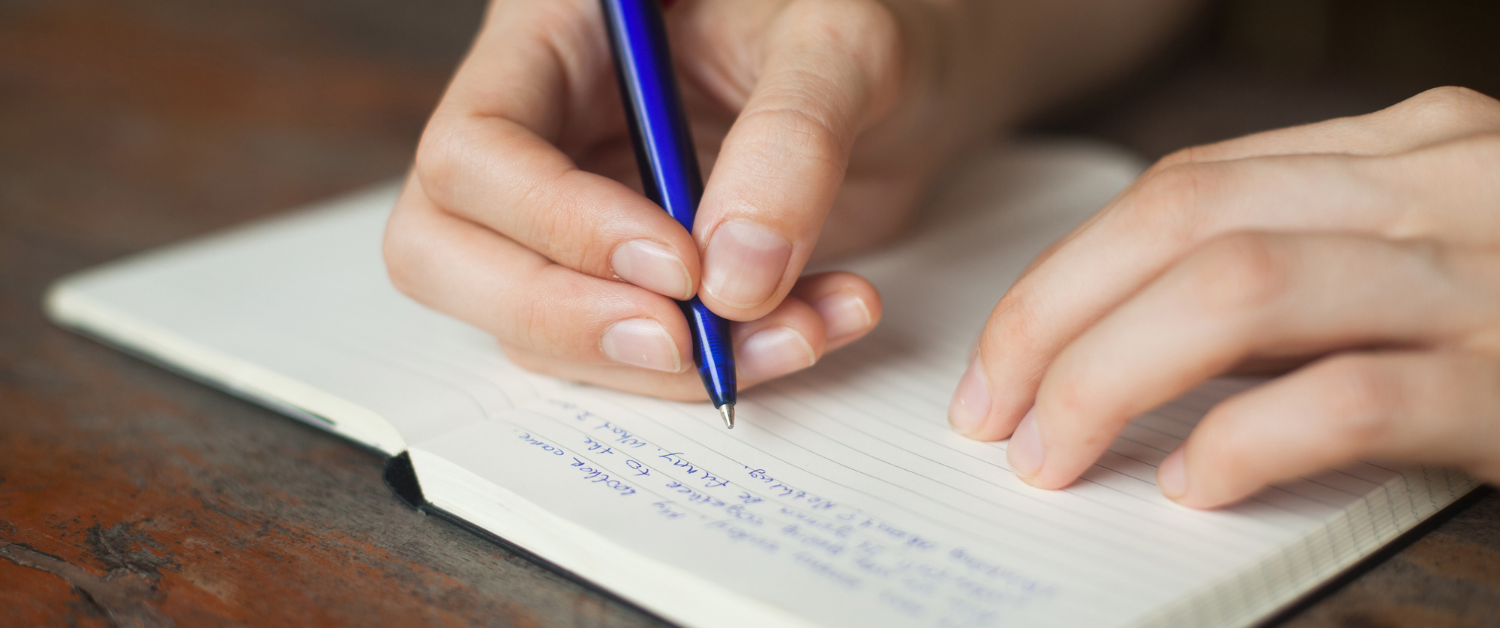
Why writing it down matters
Writing things down might sound simple, but there’s good reason it can be so effective.
There’s something powerful about taking a thought out of your head and placing it on paper.
When a thought stays in your head, it’s easy for it to be crowded out by everything else. When it’s written down, it tends to linger. It becomes something you notice again, rather than something you forget.
There’s research suggesting we’re more likely to act on intentions once we’ve written them down. Not because writing creates pressure or obligation, but because it makes the idea more real, more visible, and easier to return to when the timing feels right.
Writing something down gently shifts the odds. It gives an idea a foothold, so it doesn’t get lost in the noise of everyday life and makes it more likely that it actually happens.
Where journaling fits into this
For me, this is where journaling naturally comes in - although I should say I’m not someone who found journaling easy at first. For a long time, the idea of putting my thoughts onto paper felt overwhelming. Seeing everything laid out in my own handwriting brought up a lot of resistance, and it became a real block.
What helped was letting go of the idea that journaling had to look a certain way. It doesn’t have to be full pages, neatly written reflections, or structured prompts. Sometimes it’s just a few short phrases, or even a single word. That shift alone made it feel far more manageable.
I’ve also learnt that journaling doesn’t have to mean pen and paper, even though that’s now my favourite way to do it. A note on your phone, a typed document, or even a voice note to yourself can serve the same purpose. What matters is giving the thought somewhere to land before it disappears.
Journaling gives those quieter ideas a place to settle. It helps untangle what’s been sitting in the background and often reveals what actually matters beneath the noise. Often it’s less about setting an intention, and more about noticing one that’s already there.
The quiet joy of a new notebook
There’s also something quietly comforting about a new diary or notebook at this time of year - even if, like me, you sometimes feel a little intimidated by a completely blank page.
I’ve always loved stationery, perhaps a little too much, and I have more notebooks than I strictly need. But I’ve learnt that a new notebook doesn’t have to mean starting perfectly. It can simply be a place where pen meets paper, where ideas are allowed to arrive slowly.
There’s a ritual in it for me: choosing the pen, opening the page, enjoying the act of writing itself. My diary becomes part planner, part visual anchor, part creative expression. Somewhere thoughts can be shaped through handwriting, not rushed or typed away.
It doesn’t need to be filled neatly or used consistently. It just needs to be there, ready when something wants to be written down, and forgiving when pages are left blank.
It could be as simple as writing down…
If you find yourself with a quiet moment before Christmas, you might like to try this. Or you might come back to it later. There’s no rush.
You could write down:
Something you’ve been putting off
Something new you’d like to try
Somewhere you’d like to visit
Someone you’d like to reconnect with
That’s it. No action plan required. No deadline attached.
A gentler start doesn’t need a plan
This approach isn’t about doing more or starting early for the sake of it. It’s about giving yourself a kinder starting point.
A few quiet notes.
A softer focus.
Less pressure to get it “right”.
And if none of this feels accessible right now, that’s OK too. Resting counts. Pausing counts. Doing nothing counts.
Sometimes the most supportive thing we can do at the end of the year is stop asking ourselves to improve, and instead allow ourselves to arrive as we are.
In the words I’ve carried with me throughout 2025: just be.